What is poor man's silver? A guide to pewter and the metals mistaken for silver
Poor man's silver is an old nickname, and it usually means pewter. Pewter is a soft, grey, tin-based alloy that filled cupboards, taverns and churches when solid silver was out of reach for most households. You may have inherited a dull grey tankard, a stack of plates or a candlestick that looks like silver but feels different. This guide explains what the term means and how pewter differs from the precious metal. It also covers which observations help you tell them apart, which mistakes to avoid, and when to hand the piece to a specialist.
Quick answer: Poor man's silver is an old nickname for pewter, a grey tin-based alloy. Households that could not afford silver used it for plates, tankards, spoons and candlesticks. It resembles silver when polished, but it is a different, cheaper metal.
Where the name poor man's silver comes from
Pewter earned the nickname because of what it replaced. For centuries, people who could not afford tankards, plates, spoons, salts and candlesticks in precious metal bought pewter versions instead. Freshly made and polished, pewter has a soft, bright grey sheen. Across a dining table or in candlelight it can pass for the real thing, and it could be cast into many of the same shapes. A farming household might own a full set of pewter plates while the local landowner set the table with sterling.
The phrase described price, not quality. Pewterers were skilled craftsmen organised into guilds. Well-made pieces were repaired, or melted down and recast, rather than thrown away. Churches used pewter for chalices and flagons, and taverns used it for measures and mugs. Families passed sets down as part of an inheritance. Collectors today use the nickname with affection, and early pewter by a known maker can be sought after in its own right.
The term is loose, though. In shops, at fairs and in online listings you will sometimes see it attached to other pale metals that imitate the look of solid silver, such as plated wares or nickel-based alloys. If a seller uses the phrase, ask plainly which metal they mean. This guide treats pewter as the core meaning and covers the look-alikes separately, because each one is cared for differently and each is judged differently by buyers.
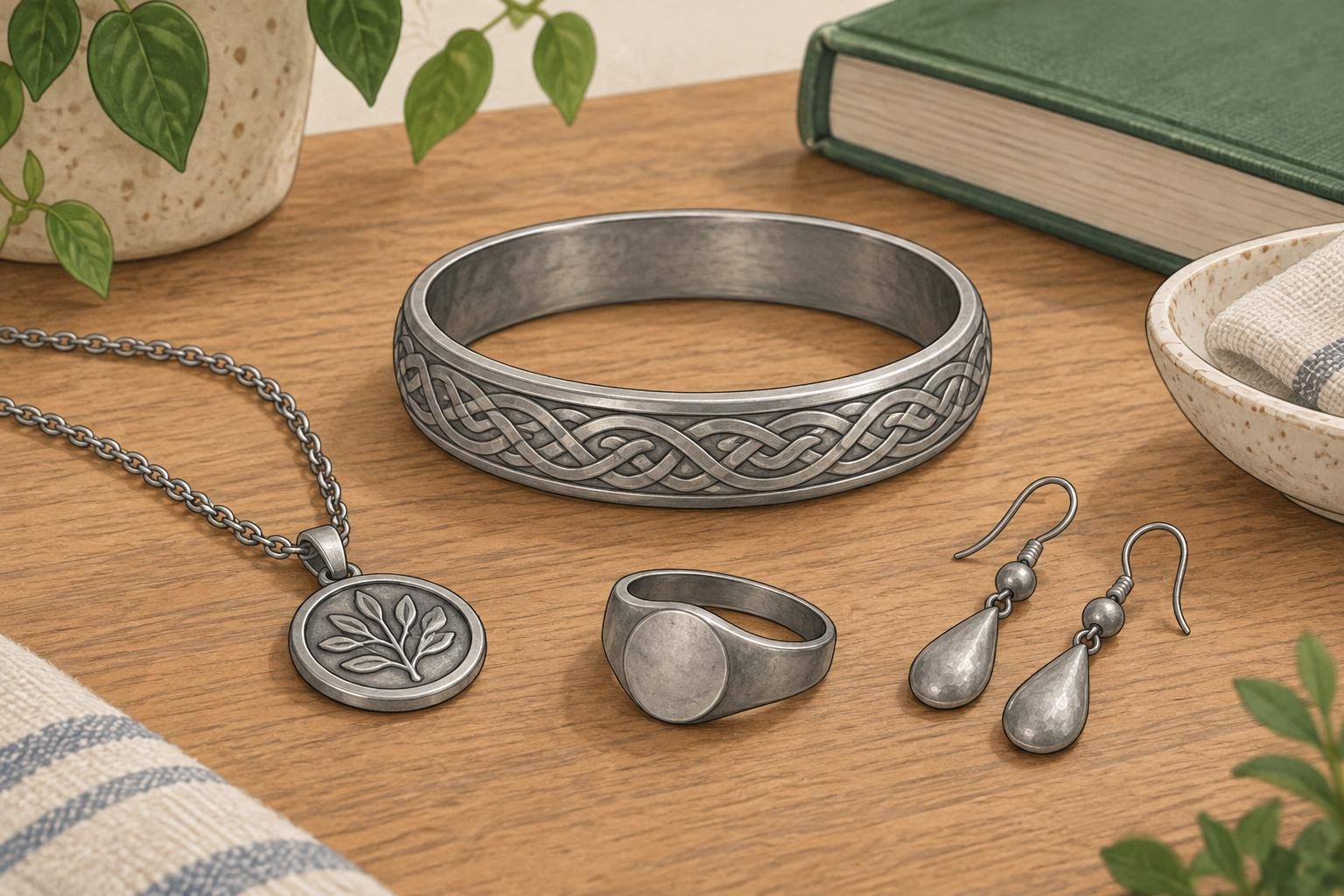
What pewter is made of, and what silver is
Silver is a chemical element. Chemists give it the symbol Ag [2] and place it at atomic number 47 [2]. Pure silver is too soft for most everyday objects, so it is usually alloyed with a small amount of another metal. Fineness figures record how much of the precious metal is in that mix.
Pewter is not an element at all. It is an alloy whose main ingredient is tin, with other metals added to make it harder or easier to cast. The recipe has changed over time and from one workshop to another. Some older pewter contained lead, which made it cheaper and darker but raises concerns about using it with food and drink. That history is why makers now stress the term lead-free pewter [1] when they sell jewellery and tableware, so buyers know which kind they are getting.
Pewter has also found a second life in adornment. It is described as the fourth-most-common metal for jewelry making [1]. Makers use it for pendants, charms, brooches and buckles because it takes crisp cast detail and costs far less than precious metals.
If you are sorting a box of inherited metalware, the practical point is simple: the two are different materials from the ground up. A pewter tankard contains no precious metal to recover, and a sterling spoon is not 'very good pewter'. Knowing which one you hold affects how you clean it, whether you should drink from it, and how a buyer or appraiser will judge it.
Pewter and silver side by side
The table gathers the main differences in one place. Its figures are the ones discussed elsewhere in this guide: the element's atomic number 47 [2], and the per-mille system of recording purity, where a 94%-pure alloy is written as 0.940 fine [2]. It also includes pewter's standing as the fourth-most-common metal for jewelry making [1].
| Feature | Pewter | Silver |
|---|---|---|
| Basic nature | A tin-based alloy, with lead-free pewter [1] sold for modern jewellery | An element, symbol Ag, atomic number 47 [2] |
| Surface over time | Not prone to tarnishing the way silver is [1] | Darkens to black silver sulfide when sulfur compounds are in the air [2] |
| Purity figure | No precious-metal content to declare | Recorded per mille, for example 0.940 fine [2] |
| Jewellery use | The fourth-most-common metal for jewelry making [1] | A long-established jewellery metal |
Read the table as a summary rather than a test sheet. Each row describes a property of the metal, but real objects complicate the picture. Surfaces get cleaned, stamps wear away, and plated pieces borrow the appearance of the precious metal. The next section explains the two observations the table points to, and where each one falls short.
How to tell poor man's silver from sterling
Two observations are worth making before anything else. Neither requires tools or chemicals, and neither harms the piece.
First, look at how the surface has aged. Silver reacts with sulfur compounds. When they are present, silver tarnishes in air to form the black silver sulfide [2] that collectors know as the dark film in engraving, around handles and inside crevices. Pewter behaves differently. Jewellery makers point out that wearers won't have to worry about pewter tarnishing like silver and other metals do [1]. Some pieces show a true black or blue-black film in the places a cloth has not reached. Those pieces are behaving like the precious metal. Others have simply turned an even, soft grey with no black deposits, which is more typical of pewter.
Second, look for a fineness figure. Silver purity is commonly recorded per mille, meaning parts per thousand, so an alloy that is 94% silver is described as 0.940 fine [2]. Numbers of this kind, often shown without the decimal point, belong to the precious metal. Our guide on what 925 means on silver jewelry explains a familiar example. Pewter has no precious-metal content to declare, so it has no reason to carry a purity number of this kind.
Each observation has limits. A plated object has a genuine precious-metal skin, so it can darken black even though the body underneath is base metal. A piece that was polished last month may show almost no tarnish of any kind. A worn piece may have lost whatever figure it once carried. If what you see leaves you unsure, stop there and ask someone who identifies metals professionally.
Tip: Before you polish or wash anything, photograph the whole piece in daylight from several angles, including the underside and any darkened areas. Cleaning removes the surface evidence a specialist relies on, and clear photos are what they will ask for first.
It can be tempting to settle the question by experimenting on the metal yourself. Resist that. Anything that alters the surface of a collectable piece can reduce its worth, and a specialist can confirm the metal without that risk falling on you.
What a fineness number tells you, and what it does not
A fineness number is the clearest link between a stamp and a precious metal, so it helps to understand exactly what it says. Purity is expressed in parts per thousand. An alloy that is 94% pure is written as 0.940 fine [2], and the same idea gives the familiar three-digit figures seen on jewellery and tableware.
What the number does tell you is a claim about content. It states how much of the alloy is the precious metal. On a grey tankard that you assumed was pewter, a figure of this kind is a reason to look again rather than a reason to set the piece aside.
What the number does not tell you is just as important:
- It does not say who made the piece or when.
- It does not prove the claim is honest, because stamps can be added to base metal.
- It does not show whether the precious metal runs all the way through or sits only on the surface.
- Its absence does not prove a piece is pewter, since many older objects carry no purity figure at all.
The number is most useful alongside the surface observation from the previous section. A grey piece that carries a purity figure and also shows black deposits in its crevices is giving two consistent signals that point towards the precious metal. A piece with a figure but an even grey surface, or with black film but no figure, is sending mixed signals. That mismatch is exactly the situation in which a specialist's opinion is worth seeking, rather than a reason to guess.
Other metals that get called poor man's silver
Because the nickname is informal, it drifts. Three groups of objects often get swept into it. Each needs to be told apart from pewter as well as from the genuine article.
- Plated wares: a base metal object with a thin surface coat of the precious metal. Because that outer layer is the real thing, it can darken black just like a solid piece, so tarnish alone proves nothing about what lies underneath. See how to identify antique silver plate versus sterling for the differences.
- Nickel silver, also sold as German silver: a pale alloy that, despite the name, contains no precious metal. It was widely used as a base for plating and for inexpensive cutlery and trinkets.
- Britannia metal: a pewter-type alloy that was spun and stamped into teapots, jugs and tableware. Do not confuse it with Britannia standard, a genuine precious-metal grade of higher purity than sterling.
The same caution applies to coins and small collectibles, where pale base metals are common. If you are sorting a coin jar rather than a cupboard, read how to tell if a coin is silver and how to spot fake silver collectibles.
When a seller uses the nickname, ask whether they mean pewter, plate or one of these alloys. A clear, specific answer tells you a good deal about how well they know the piece.
Buying and selling pieces described this way
The nickname turns up often in house clearances, auction lots and online listings, and it is used inconsistently. A few habits protect you on either side of a sale.
If you are buying, ask the seller to name the metal outright. Ask where the piece came from, whether it has been repaired, and whether it has been polished recently. A dealer who knows the stock will answer plainly. Vague answers, or a listing that leans on the nickname without saying what the object is, suggest the seller has not looked closely either.
If you are selling, describe what you know and what you do not. A photograph of the untouched surface, a note on where the piece came from, and an honest statement that the metal has not been confirmed will serve you better than a confident label that turns out to be wrong. Buyers who collect pewter often prefer pieces with their aged surface intact, so resist the urge to make an object shine before listing it.
Keep in mind that the market for pewter and the market for the precious metal are separate. A pewter plate is judged on age, maker, form and condition. A sterling piece is judged on those things and on its metal content as well. Putting an object in the wrong category, in either direction, is how both buyers and sellers lose out.
Mistakes that cost money or damage the piece
Warning: Do not drink or eat from old pewter until you know what it is made of. Lead content cannot be judged by eye, and some historical recipes included it. If you want pewter on the table, have the piece assessed first, or use modern items sold as lead-free pewter [1].
Warning: Do not clean pewter as if it were sterling. Dips and abrasive polishes are designed for the black film on the precious metal. On pewter they can strip the soft, aged surface that collectors value, leaving a piece that looks new and is worth less. Old pewter that has darkened evenly is usually best left alone until a specialist has seen it.
Other mistakes cost money rather than metal:
- Dismissing a heavily blackened object as 'just pewter'. Silver darkens to black silver sulfide [2], so a black-coated piece may be sterling or plate and deserves a closer look before it goes to a charity shop.
- Assuming a grey piece with no purity figure must be pewter. Worn or unmarked pieces exist in every metal.
- Trusting the nickname in a listing without asking which metal the seller means.
- Cleaning before photographing. Wear patterns and tarnish are evidence, and a specialist will want to see them as they were.
- Assuming pewter is worthless. Early, well-made or maker-attributed pewter has its own collecting market, so condition matters.
When to ask an expert, and a faster first look
Some questions cannot be settled at home. Bring in a qualified appraiser or a specialist metals dealer in any of these situations:
- The observations above leave you unsure which metal you have.
- The surface and the purity figure seem to point in different directions.
- You plan to sell or insure the piece.
- Anyone intends to use old pewter with food.
Professionals have the equipment and reference material to confirm the metal safely, and they can place a maker's work in its proper period.
Prepare before you go. Bring your photographs, a short history of where the piece came from, and a list of any repairs, dents or replaced parts you have spotted. That saves time and helps the specialist focus on the details that matter.
You may want a quick starting point before booking anyone. Antique Identifier can identify a piece from a photo, describe its likely materials, era and style, and give a market value estimate for research. That estimate is not a formal appraisal for insurance or estate purposes. Use it to decide which pieces are worth taking further, not as a final answer.
Common questions
- Why was pewter called poor man's silver?
- Pewter could be cast into the same plates, tankards and candlesticks that wealthy households owned in silver, and when polished it had a similar pale sheen. It cost far less, so families who could not afford the precious metal bought pewter instead, and the nickname stuck.
- Does poor man's silver contain any real silver?
- Pewter is a tin-based alloy and is not silver, so you should not expect to recover any precious metal from it. Some items sold under the same nickname are plated, in which case only a thin surface layer is genuine.
- Is antique pewter safe to use for food and drink?
- Not until you know what it contains, because some older pewter was made with lead. Treat old pieces as display items and ask a specialist before using them at the table.
- Is pewter valuable to collectors?
- It can be. Value depends on age, maker, condition and how much of the original surface survives, and early or well-documented pieces attract serious collectors. An appraiser can tell you where a particular piece stands.
- Should I polish a dull grey piece to find out what it is?
- No, leave it as it is and photograph it first. Polishing can damage an old surface and remove the tarnish patterns that help a specialist identify the metal.